
The First 10 Members: Seeding a Discord Server That Feels Alive
An empty server kills itself. The first ten members decide whether the eleventh stays, and you get almost no second chances at that impression.
A server with four members and eleven channels reads as abandoned. A server with four members and two channels reads as early. Same people, completely different decision from the person deciding whether to stay.
This is a plan for going from zero to a room that a stranger would post in.
Before you invite anyone: strip the server down
The most common mistake in a new server is building the structure for the server you hope to have in a year.
Delete everything down to this:
- One general text channel
- One channel for the actual topic, named after the topic and not after a category system
- One voice channel
- A rules or welcome channel, three to six lines long
That is it. No #introductions with nobody to introduce yourself to. No #suggestions, no #memes, no #off-topic, no roles beyond you and a moderator role you have not filled yet. Empty channels are visible evidence that nothing is happening, and every extra one dilutes the conversation that is happening into a quieter room.
Add channels when the existing ones are too busy. That is the only trigger. If people are talking about two things at once in #general and stepping on each other, split. Not before.
Members 1 to 3: people who owe you a favour
Do not recruit strangers first. Recruit people who will reply to you even when the conversation is slow, because for the first week you are the conversation.
Pick three people who fit at least two of these:
- They already talk to you regularly somewhere else
- They actually care about the topic, not about supporting you
- They are online at a different time of day than you are
That last one matters more than it sounds. Two people in the same timezone produce one active window a day. Three people spread across two timezones produce a server that looks alive whenever someone checks it.
Message them individually. Never in a group. Say what the server is for in one sentence, say you want them specifically because of a thing they know or do, and say what you want them to do this week. "Come hang out" produces a join and then silence. "I want somewhere to argue about patch notes and you have the best takes, can you post your read on the current meta" produces a message.
Members 4 to 10: seed a reason, not a room
Now you can recruit people who do not know you. The pitch is never the server. The pitch is a specific thing happening inside it.
Things that work:
- A weekly event with a fixed time. Movie night Fridays at 20:00 UTC. A ranked stack that queues Tuesdays. A critique round every Sunday.
- A resource that only exists there. A curated list, a shared spreadsheet, a bot you set up that does something niche and useful.
- An ongoing project. Anything with a state that changes gives people a reason to come back and check.
Things that do not work: "chill community", "active vc", "friendly staff". Every dead server on the internet says exactly those words.
Recruit where your topic already has a crowd. A comment in a subreddit thread where you actually answered the question, then mentioned the server, will outperform fifty posts in a server-advertising channel. People in advertising channels are there to advertise, not to join.
Set the culture in the first 200 messages
Whatever the first ten people do becomes the norm. If the first ten posts are one-word replies, that is your server's register forever.
Concretely, for the first two weeks:
- Answer every message. Every single one, within a few hours. A message that gets no reply teaches the sender not to send another.
- Post the kind of message you want back. If you want detailed posts, write detailed posts. Nobody writes three paragraphs into a channel full of "lol".
- Name people. Ping the person who said the thing you are responding to. It makes a four-person channel feel like a conversation rather than a bulletin board.
- Ask questions with a wrong answer. "How's everyone doing" gets nothing. "Is X actually better than Y after the nerf, because I think it isn't" gets an argument, and arguments are traffic.
Add exactly one bot, and make it do something visible
A new server does not need a moderation stack. It needs one bot that produces a reason to open the app.
Good first picks depend on the topic: a stream alert bot if your members create, a leveling bot if you want visible progress, or something from utility bots that automates the thing your topic revolves around. Auto-moderation can wait until you have enough traffic to have a problem.
One bot, configured properly, beats six bots that each post one unread embed.
Then make the server findable
At around ten active members you have something worth showing strangers: real messages in the scrollback, a visible last-active time, and at least one recurring thing on the calendar.
That is the point to list the server in a directory, because now a visitor who clicks through lands in a room with evidence of life rather than an echo. Write the description around the specific thing you seeded, tag it with the words a searcher would actually type, and bump it on a schedule rather than in bursts.
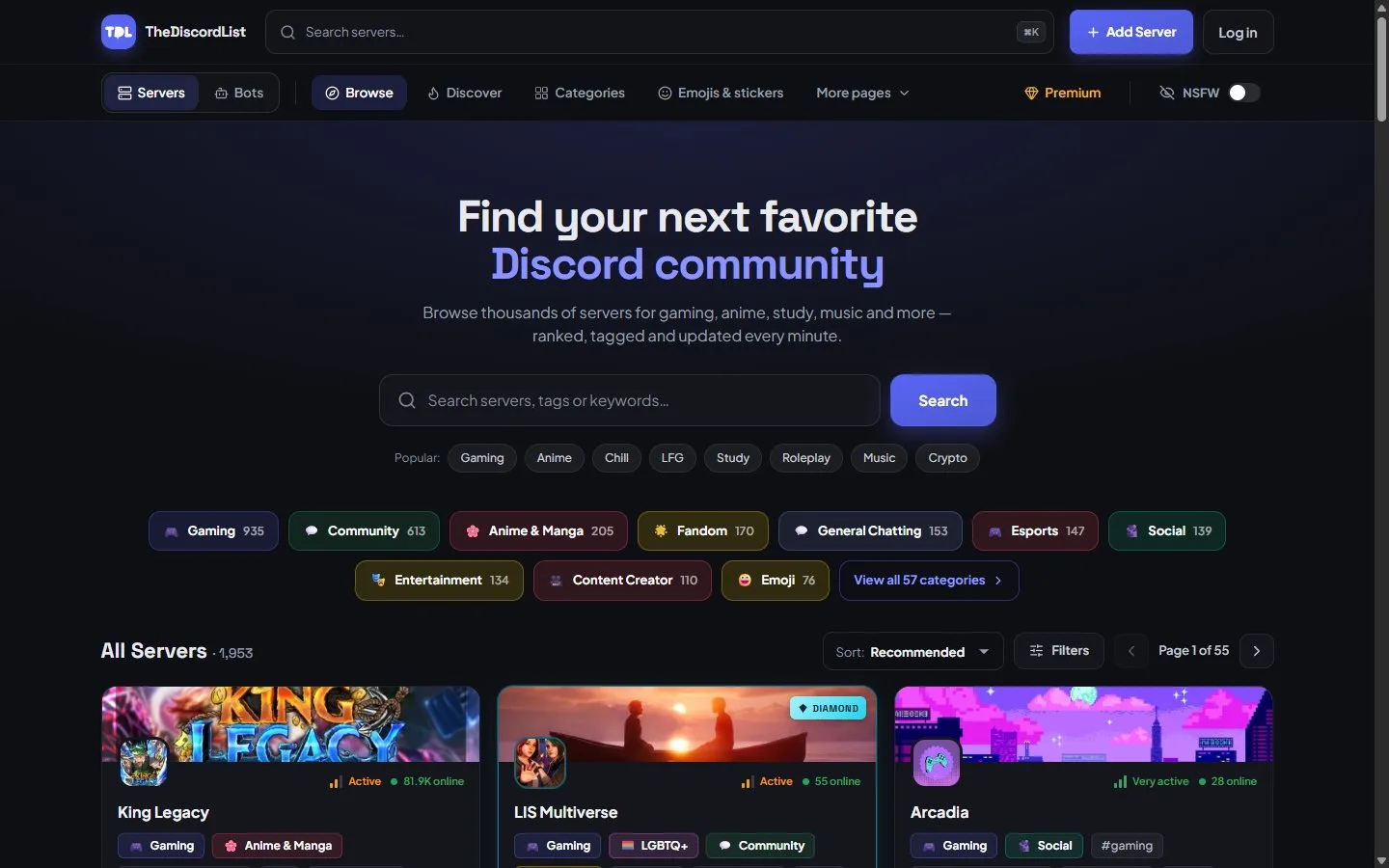
Listing is free, and new servers get the heaviest ranking boost in their first weeks.
This week: delete every channel nobody has posted in, and message three people individually with a specific ask.